
System Architecture
Overview
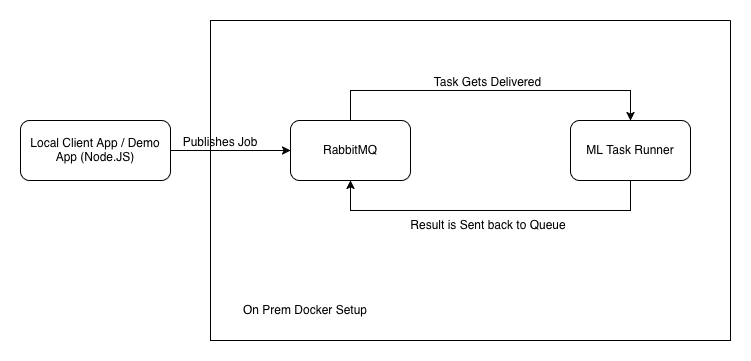
Authenta On-Prem is built as a modular, containerized system that can run entirely within your organization's network.
All inference processing, task management, and result storage happen locally — ensuring full data confidentiality and compliance.
At its core, Authenta consists of three primary components:
- RabbitMQ — Message broker that orchestrates inference jobs
- ML Task Runner — Python-based container that executes the AI model (CPU or GPU)
- Shared Volume — Host directory mounted into containers for input and output exchange
These components communicate internally through a secure local Docker network.
Once deployed, the system can run indefinitely in an air-gapped (offline) mode.
Component Diagram
Component Details
📨 RabbitMQ (Message Broker)
- Acts as the central hub for task dispatch and result collection
- Exposes a single queue (default:
task_queue) - Used by internal or external applications to publish jobs and receive inference results
- Includes a management dashboard at
http://localhost:15672for monitoring queues and message flow
🧠 ML Task Runner (Inference Service)
- Containerized Python service that loads Authenta's trained models
- Processes incoming jobs from RabbitMQ and executes the appropriate detection model
- Available in two profiles:
- ml-task-runner-gpu — optimized for NVIDIA GPU acceleration (default)
- ml-task-runner-cpu — for CPU-only systems
- Writes inference outputs and logs to the shared host directory
- Scalable: multiple task runner containers can be deployed for parallel job handling
📂 Shared Host Volume
- Mounted as a local directory on the host system (e.g.,
/opt/authenta/data) - Used for:
- Uploading media files for analysis
- Storing model inference results and logs
- The ML task runner reads from and writes to this volume directly
- Ensures all content stays within your environment with no external storage dependency
Internal Communication
- All services communicate over an internal Docker network
- RabbitMQ and ML Task Runner exchange messages securely without leaving the host
- No ports are exposed externally unless explicitly configured (except for RabbitMQ dashboard if enabled)
- You can further isolate services using your own network namespace or container firewall rules
CPU vs GPU Profiles
| Profile | Service Name | Description | Requirements |
|---|---|---|---|
| GPU | ml-task-runner-gpu | Default profile leveraging NVIDIA CUDA acceleration for faster inference | NVIDIA driver + Container Toolkit |
| CPU | ml-task-runner-cpu | Compatible profile for systems without GPUs | Docker only |
Both profiles are defined in the provided docker-compose.yml file.
You can start either profile as needed:
# Start GPU profile (recommended)
docker compose --profile gpu up -d
# Start CPU profile (fallback)
docker compose --profile cpu up -dOffline Operation
After the initial image pull from Authenta's private AWS ECR, all components can run offline:
- No outbound API calls or telemetry
- No internet connection required for inference or logging
- Optional network hardening:
- Block all outbound traffic
- Allow only internal container-to-container communication
This ensures complete data isolation and compliance for secure or regulated environments.
High-Level Data Flow
- A client application publishes a JSON message (task) to the RabbitMQ queue
- The ML Task Runner consumes the message and retrieves the referenced input file from the shared directory
- The model performs inference (deepfake, AI-generated, or forgery detection)
- The resulting metadata and detection scores are written back to the shared volume
- The result is optionally sent back to the client application through RabbitMQ or HTTP callback
Scalability
Authenta supports horizontal scaling out of the box. You can deploy multiple ml-task-runner containers — RabbitMQ will automatically distribute jobs among available consumers.
Example:
docker compose up -d --scale ml-task-runner-gpu=3Each container instance processes tasks independently, enabling higher throughput for batch or real-time use cases.
Summary
| Aspect | Description |
|---|---|
| Deployment Type | Docker Compose (CPU or GPU) |
| Core Services | RabbitMQ, ML Task Runner, Shared Volume |
| Data Flow | Queue-based message dispatch and local file I/O |
| Scalability | Multi-instance ready |
| Security | Offline, isolated, no external dependencies |